Showing posts with label Ethiopian culture. Show all posts

27 September, 2010

Bonfires & Rockets


Rockets were ignited; the sound deafening and chaos erupted in the streets of Dangila. There was a sigh of relief when I finally made it safely inside the gates of my compound as darkness fell around me.  I stared for a moment at my red-stained hands and reflected on the pandemonium the day held.

I went to bed last night after double-locking my door and comforting my dog who was scared as small explosions popped loudly near my front door.  Around 3am I awoke to silence and was thankful for the peace it brought me, but at 5am the noise was once again inescapable.  I peered out my window and saw that fires were raging in the street and smoke filled the air. Time to join the celebration, I finally conceded!
Today was my first Meskel holiday spent in Dangila and it quickly had turned into my favorite.  Ethiopia has a lot of obscure holidays, but most are celebrated in the same fashion: coffee ceremony, killing a sheep, eating injera.  But Meskel proved to be a unique and wonderful reprieve from the monotony of holidays here.

Although the holiday is officially today, Monday, September 27, 2010 (Gregorian calendar, because let’s not forget we just rang in the year 2003 in Ethiopia), Meskel celebrations began yesterday.  All over town cone-shaped bonfires were built and children anxiously ran amuck in the streets wanting to set fire to them.  But their parents' warnings halted their pyro-instincts.
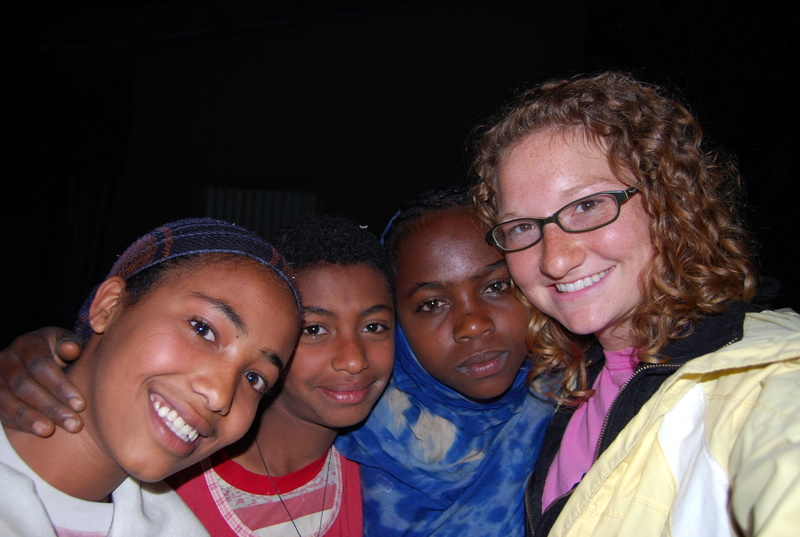
I visited neighbors’ houses all day yesterday, which officially started the holiday and the process of being over-fed.  At one house, “the house of 5 girls” as I’ve labeled them, I came in just as the henna mixture was ready for application.  I accepted the fact that my hand was going to get the same treatment as theirs without a word and enjoyed my girl-time with this wonderful family.  As I sat there letting the henna dye my skin I thought about how majestic the henna dye looks on habesha hands, blending the natural golden brown skin on the back of the hand into a deep red palm.  Then I looked at my pale hand and realized I’d inevitably look like a kid who stuck their hand in Georgia clay or Kool-Aid, but what could I do about it now?


Hands stuffed in my jacket pockets, I continued to visit neighbors and enjoy the atmosphere.  I stopped to hangout with some children on my street for a while and they showed me their clever invention made from an old metal pipe and a nail all strung together with wire.  If you scrape off the head of a match and put it in the pocket formed by pipe and nail, and slam it against a rock, it creates a loud POP sound.  Some kids buy fifty sentim “rockets” which create a much louder effect, but using matches proved cheaper, so most kids opted for this method of being annoying.

The kids and I watched as parents built the bonfire tower out of wood and wrapped it in fresh evergreen branches which by the end resembled a Christmas tree by both sight and smell.  They told me the bonfire would be lit at nine o’clock, which would normally translate immediately in my head (there is a six-hour difference), except for some reason 3am seemed an unfathomable meeting time and instead 9pm stuck.  It wasn’t until 8pm, after I returned home from watching the Addis Ababa bonfire igniting on ETV and reminisced in my head about my Meskel spend there last year, that it clicked with me that the kids meant 3am!  I immediately wanted to double-check because I wasn’t going to be the fool who wakes up in the middle of the night for nothing, but at this point I was home, in my pajamas, and safe from the raucous in the street.  My final walk home just 30 minutes before was filled with dodging little boys running up with their fire-cracker invention and popping it at my feet; no way I was going back out.

I went to sleep cursing the children who kept throwing the rockets over my compound fence which would then explode in noise on my porch.  At 3am I awoke without an alarm from a loud but comforting noise, rain pounding on my roof.  The street itself was quiet though and I easily put my head back down to keep sleeping.

Around 5am was the next time I woke as children screamed with joy and rockets once again began their popping.  I threw on a jacket and hurried outside, unsure what to expect.  My neighbors happily greeted me and handed me a small bundle of sticks.  The streets where pitch black except for bonfires ablaze on each block.  My neighborhood’s bonfire was just about to be ignited and I joined in carrying the flame from an already burning fire to ours.  We chanted yohey, yohey, yoho, yoho lead by an elder and danced in a circle around the Christmas tree-like structure, then we lit it with our bundles of sticks.  The bonfire went up in a blaze and smoke from the green branches filled the air.

Bonfires eventually turned into ashes and darkness turned into a beautiful sunrise.  Corn was roasted on the remains of the fire and neighbors began their holiday celebration together in the street.  The rest of today has been spent bouncing back and forth between neighbors to accommodate all the bunna invitations; there have been quite a few coffee ceremonies.  Despite the number of cups of coffee I’ve had to drink today, the caffeine couldn’t overpower my four hours of sleep last night.  What a wonderful holiday; it will end the only way a good Ethiopian celebration can end: with a deep sleep!

31 August, 2010

A Grand Welcome


I’ve written before about Ethiopian hospitality and how it’s unrivaled, but even after living here for so long it still knocks me off my feet sometimes.  I’m a fairly hard person to surprise. I see things coming, read into foreshadowing, and pick up on subtle signs. But this incredible hospitality often gets past my radar and surprises me more that anything.
The morning after my friend from home, Chris, arrived in Ethiopia I made him board a bus at 5am heading north to Dangila.  This ride is something I’ve become used to enduring by now, although it never can end soon enough.  Around 3pm we finally arrived in Dangila, exhausted from the journey.  We loaded our luggage into a bajaj taxi and were taken straight to my house.  As I opened the gate to my compound, waiting patiently inside was my student/friend Aregach.  As we got all our belongings inside I realized she went back outside and was bringing in a pot and basket, filled with the special holiday food duro wat and injera.
I later found out that Aregach, who had been fasting from meat for two weeks (as were all Orthodox Christians), postponed her holiday celebration by several days just so she would have duro wat (chicken stew) for our arrival.  She also came over to my house over two hours before we arrived by bus and waited patiently for us to show up!
 My new friend/neighbor Taish came over to join the celebration as well.  The four of us ate the delicious food and hung out for a couple hours which was more than anything I could have asked for. Aregach is such a wonderful friend and she teaches me new things every day about loving and giving. It was a great welcome back to Dangila.
During Chris’s week-long visit in Ethiopia we only stayed in Dangila for a couple days, which meant we had a LOT of coffee and food invitations to squeeze into a short amount of time.  And Chris had only been in Ethiopia for less than 24 hours when we got to my town, meaning his experience with, and acquired taste for injera was minimal.  He was a great sport to eat whatever happened to be put in front of him.

After we went to my final class of my summer English club, one of my students invited us over for coffee and lunch.  We enjoyed listening to American music (from the CD I’d given my perfect attendance students as a prize), drinking the three rounds of delicious coffee, and stuffing ourselves with yet another meal of injera and wat.  I think by this point Chris was finally getting the hang of what my life is like here!
Then finally, on our last day in town, we stopped in my neighbor’s house to say “hi” and found ourselves leaving several hours later, stuffed to the brim.  It was not altogether unexpected since I often spend hours at a time laughing and eating in their house, but it surely was nothing less than an adventure with Chris there.  We sat for the longest time just drinking the rounds of coffee as I played translator between the family and Chris.  We were all set to leave when the mother insisted on making something for us to eat (since she had promised me the week before that she’d make something special when my friend arrived), so we got comfortable knowing there is no turning down such a generous invite.  Luckily we saw Taish walk passed their house and called him in to eat with us, adding another stomach to divide the food between.
Dangila is full of surprises and every time one of them hits me, it makes me want to stay until I discover them all.  With the end of my time here in sight I really am trying to live every day to the fullest, and sometimes that is referring to the state of my stomach.  The culture I’ve experienced here of entertaining neighbors and guests is something I hope to carry with me throughout life.  It is beautiful, selfless and loving. I think we can all learn something from a culture like that.  On that note, I’m here for five more months and very open to more visitors… any takers?

30 August, 2010

Ethiopia Through New Eyes


This week I’ve had the privilege of introducing one of my good friends from home, Chris, to Ethiopia.  It’s been filled with adventures and bus rides, but one of my favorite things is hearing his impressions of life here, giving me a new perspective of seeing things.  Being here for over a year and a half I have certainly become adjusted to life and I often don’t see the peculiar things anymore.  I love the comfort this brings to my everyday life; seeing all these things as normal makes me feel more at home.  But it is refreshing to hear about all the surprising parts of Ethiopia which once also stunned me.  I’ve decided to make a list to share so that you can all start to understand the basic differences which I somehow find normal.

•    Constant reminders from locals to “eat!”
•    Affection between guy friends: holding hands, hugging, etc
•    People feed you by hand as a sign of respect
•    Coffee cups between the three rounds of coffee are often mixed up but we never question which we receive
•    Showers are optional
•    Time here is six hours off (noon = 6:00)
•    It is 2002
•    Ethiopians are deathly afraid of dogs/puppies
•    Animal dodging while in minibuses
•    People in the middle of nowhere – people are everywhere
•    Injera for every meal is common

More updates to come about my travels!


10 May, 2010

St. Mary’s: The Ethiopian Block Party

Time is flying by and already I find myself celebrating St. Mary’s holiday without knowing it, again.  Last year you’ll recall I drank coffee with my landlord’s family and neighbors on their front porch, only later to find out this is how they celebrate St. Mary’s holiday.  This year I knew it as soon as I saw it, but still didn’t realize the holiday was approaching until the rest of town was well into their celebration.

Unfortunate scheduling had me rushing to an appointment across town yesterday afternoon to tutor a couple of the orphan boys I met last fall.  I hadn’t done much in the physical movement department on my lazy Sunday so I decided to walk, taking the shortcut through back streets instead of the paved main road.  What I didn’t know from my celebration of the holiday last year was that those without front porches instead celebrate with neighbors out in front of their houses or in the yard within their compounds.

It didn’t take me long to realize the holiday was being celebrated, neighbors from every single celebration calling me to join their party.  I kept repeating my excuse, “I have an appointment, but thank you for inviting me! Happy holiday!” while taking a obligatory scoop of nefro in my hand as I walked away.  Nefro is the holiday specialty treat, a mixture of boiled beans, corn, chick peas and barley eaten by the handful.  A few more persistent neighbors wouldn’t accept my excuse and insisted that I at least sit down for a minute to celebrate with them.

After a few blocks of walking it was comical, literally every celebration bringing me a plate of nefro for me to take a handful from.  At any single point of my journey I had nefro in hand, barely finishing one household’s snack before politely taking some from the next.  It figures that about half way to my appointment my landlord’s family calls me, beckoning me to come drink coffee, and, of course, eat nefro.  I knew I had to go; I already missed their big Easter celebration with neighbors and felt horrible.  I debated turning around, retracing my steps back to my house right then, but thought the path of least resistance (without having to explain my sudden return to every celebration along the way) was to continue to where I was going, which was on the main road, and from there I could get a bajaj taxi back to my house.

The second half of my walk turned out to be the same pace as the first half.  Five steps forward, two steps back, one scoop of nefro, repeat.  I was impressed by how many of the celebrations had at least one person who knew my name, meaning there were hardly any “ferengi” calls.  I finally made it to the main road and waved down a bajaj, never making it to my appointment.  Luckily appointments here are easily rescheduled, and hardly ever obligatory.  And I didn’t disappoint my landlord’s family, whom I’ve come to think of as my own family.  I managed to turn a simple walk across town into a joint-celebration with more families than I can count, on a holiday I didn’t know was going on!

20 April, 2010

The Culture of Hospitality


Every time I come back from being out of town I receive the warmest “welcome back!” from the society as a whole.  Almost every day now I receive some sort of invitation for lunch or coffee at a friend or neighbor’s house.  Ethiopians are truly the kindest people who embody the idea of a culture of hospitality.  But there was one thing I didn’t experience until just now, how this culture treats you when you’re sick.

I have to say that I am very blessed not to have been really ill at all during the past 17 months, in fact this past weekend was the first time I’ve ever even had a fever.  I felt achy enough to call in sick for the day, knowing I wouldn’t want to get anyone else sick in case it turned into something worse.  The phone call went something like this:
“I know I mentioned I felt like I was getting sick, and today I feel worse, so I’m going to stay home today.”
“Oh, Jennifer! I will come to visit.”

The notion that when you’re sick you’d rather be alone, sleeping, is completely foreign here (literally).  Ethiopian culture is that when you get sick, everyone visits.  I understand that sometimes it is nice to have a friend stop by to see if she could bring you something, but here it is cultural for everyone to stop by, just to make you feel better!  I kindly refused most self-invitations, insisting that I would be fine to just sleep, but politely not mentioning that having my entire office and other co-workers come to my home while I’m under-the-weather wouldn’t exactly help.  Imagine in America your boss showing up at your house 20 minutes after you’ve called in sick!

On top of my co-workers’ sympathy, word of my sickness spread like wildfire around my compound and neighbors all stemming from the 8-year-old daughter of my landlord.  She’s the only person I told I was sick when she knocked on my door wanting to play, and from then on every person on my compound (there are 8 others) needed to hear it for themselves.  I also realized that I don’t know the Amharic vocabulary for things such as fever, tonsils, and congestion.  Always an opportunity to learn!

Happy to report that 48-hours later I’m back to normal.  Luckily it was just a minor bug because I think the neighbors would have gone crazy in anticipation of me feeling better! I do love this culture though; everyone is always looking out for you!

05 April, 2010

The Fourth Invitation

To continue my story of Fasika, Easter in Dangila, at 4pm I returned to the house of my fourth invitation of the day.  Earlier in the day I was only able to drop in for a brief serving of duro wat, so of course I was expected to come back later to machewat, play.  More than that, I wanted to go back; I find myself visiting their house just about every day now to hangout with this wonderful family.
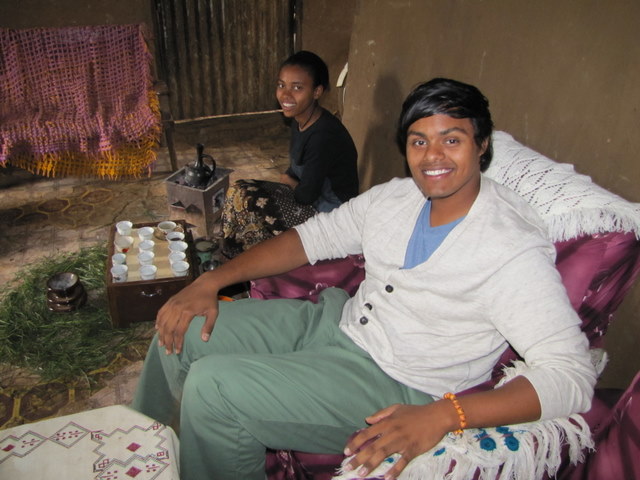
Invitation 4: my “house of 5 girls” I call them.  I may have mentioned them before, but I adore this family.  The littlest girl from the family is in my little “street gang” of children that chants my name as I walk to the post office.  I should mention that by “gang” I mean group of toddlers, most of whom don’t wear pants or shoes, but play in the street around my house, and with whom I have a mutual adoration.  One day a while back, I accepted a coffee invitation from this family (meaning they yelled from their house “drink coffee!” as I walked past) and have been an honorary family member ever since.  The mother is very traditional and comes from the rural area while her four daughters are rather modern in comparison.  The eldest of the four moved to Addis a few months back, but left her daughter to be cared for by the family, who is Meskerem, the little girl in my “gang.”  The youngest of the four daughters is mentally handicapped and blind.  The two middle daughters are around my age and know a decent vocabulary of English, so often, when composing sentences will throw in an English noun of two for me.  The second oldest is exactly my age actually, and she will often offer to paint my nails while I’m sitting in their house, which I always kindly accept.  The roughly painted coat of polish typically lasts 3 days and serves as a wonderful reminder of how much I am loved in Dangila for those few days.  I doubt any manicurist in America will ever quite suffice.
Most of all, I love and admire the mother of this family.  How strong would you have to be to not only support four daughters by yourself (ok, husband is around, but let’s just say he doesn’t really do much for the family) but also take in your granddaughter, not to mention the fact that one daughter is handicapped.  This whole family lives in a house the size of my house: a mere 20-square meters.  Ethiopian mothers do everything, especially those not fortunate enough to have a helper like my landlord’s family has.  You prepare injera and wat from scratch, clean the clothes by hand, and sweep the dirt floors until they are spotless.  The work is never ending.  Every time I come by, they insist on feeding me, finding it insulting when I refuse.  On Easter, as a treat, I brought them a half-kilo of coffee beans (worth 30 Birr = $2.50) and the mother, Fantanesh, was beside herself, almost refusing to take it.  I justified the gift by saying that I cannot perform coffee ceremonies, so this is simply all the coffee I drink at their house.  She then wouldn’t let me leave until she prepared a special ceremony just for me.
I always want to give them something; I want to give them everything.  Yet they are so humble, not wanting anything.  Some people don’t know anything about me other than the color of my skin yet boldly ask for money while the people who I know and love won’t even accept the smallest gifts.  It’s hard.

More stories from the “house of 5 girls” to come.  For now, I should end my Easter stories so I can finally digest all the food I ate.

Final Count:
Plates of duro wat eaten: 3
Plates of tebs eaten: 2
Cups of coffee drunken: 9
Number of times I had to remove a sheep’s head from Arbay’s mouth: 3
Piece of raw meat Arbay hid in the sofa cushions: 2

Fasika, Take Two


‘This is wonderful duro wat!’ I complimented my landlord’s wife, as is cultural here in Ethiopia.

‘If it is wonderful duro wat that means it will be a wonderful Easter!’ she replied.

A great omen I thought for the day ahead.  Good thing too, since it was bound to be a long one—that first helping of duro wat was served to me at 6am this morning.

As I prepared my new group 3 neighbors for the biggest Ethiopian holiday celebration, I had one piece of advice for them: don’t over-commit yourself!  I have been anticipating Easter for a month now, and knew that while I was going to thoroughly enjoy the holiday here in Dangila, this year would be different; I wasn’t going to tell more than two families I would come to their houses on Easter.  Somehow, that plan went awry.

Last year I think I accepted any invitation that came my way, an "I’ll-take-what-I-can-get" kind of attitude.  As you can read from my blog last April, I had far too many commitments for one day, and had no idea what I’d gotten myself into.  This year it was a completely different situation; I have so many wonderful and close friends that I simply couldn’t refuse people’s offer for me to spend the holiday with them and their families.  And I knew exactly what I was getting myself into, but I just couldn’t say ‘no.’  Moreover, because I have such close friends it was less an invitation and more a statement of what time I was going to be at their houses on Easter Sunday.  Three such invitations presented themselves throughout the past week and I obliged them all with a grateful acceptance, but I will admit the fourth invitation was not exactly unsolicited.

Knowing Easter was approaching, I couldn’t have imaged not spending part of my day with Tizita’s family, who I spent Easter morning with last year.  Something about having a constant between the two celebrations was appealing, so I planned on having lunch at Tizita’s family’s café on Thursday before Easter, hoping to secure an invitation.  Worked like a charm; I hadn’t even placed my order for lunch before Tizita’s mom asked if I was going to be in Dangila for Easter.

So with all the invitations in place I anticipated a long day with way too much food, but I was looking forward to the festivities as if it were Christmas day! Easter is such a huge holiday here that I suppose I really did get wrapped up in all the preparations and I was also looking forward to finally breaking the fast!  I woke up at 6am and hopped right out of bed, knowing my compound family would already be awake and enjoying the first course of meat for the day.  As soon as they realized I was awake they summoned me inside for a tasty platter of duro wat (chicken stew—the holiday specialty).  For all you injera-lovers out there, well, anyone who actually knows good Ethiopian food, it was more than just good wat, but tequs injera, freshly made within the hour—yum! 

And so the day had begun, the fast had been broken, and my only obligation for the day was to eat! I brought the children some Easter candy and unwrapped a few myself before I witnessed the first sheep slaughtering of the day by my landlord.  Then I was off to Tizita’s family around 9am (I received 3 different times from 3 different family members about what time I should arrive, so I decided on a 9am average).  I was promptly served another platter of duro wat—a whole tequs injera all to myself. As the day began I savored every bit, eating to fill my stomach with the delicious food.  Next came a coffee ceremony with a snack (as is required for the ceremony) followed with a platter of homemade “cheese” (old milk), and I began to realize that fasting has its perks in Ethiopia.  In fact, I realized all of my favorite Ethiopian foods are fasting foods, but I politely ate my fair share of all the holiday goodies.  I knew Tizita and her family would never let me leave before having some of the first platter of tebs from the second sheep of the day I just witnessed slaughtered.  So I waited for the food and finally left after tebs right around noon. 
I loved being invited back to Tizita’s family’s celebration.  It was such a treat for me to be in a familiar place with familiar people and to have an idea of what to expect.  Year 1 here I may have been comfortable with the people, but the traditions surrounding each holiday were still a mystery—moreover, it is like Christmas in America, where every family celebrates in a different way, so it isn’t something you can simply be taught.  Those three hours spent at my favorite little café, with a family who loves me and knows me was relaxed and easy.  And although it had differences from the year before, the major constant, which I expected, was that for those three hours I continually had a plate of food in front of me, and was continually told, “Be!” eat!

I should have known that appointment would have lasted until noon, but I guess I was optimistic about the amount of time it takes to slaughter a sheep, so now I found myself with my third invitation starting at noon and had just received a phone call from the fourth telling me to come now!  I swung by number four, ate a quick plate of duro wat, ran home to grab some candy for the kids at the next house, and luckily caught a bajaj to the other side of town for invitation number three: Yebeletal and his family.  He is my co-teacher for the English Club and a wonderful friend; his house had recently become a place I have frequented, especially since his wife just had a baby girl whom I adore!
Arriving 30 minutes late for the appointment, I was surprised to see that I was the last to arrive—surprised because Ethiopians are never on time.  However, I was greeted with warm smiles, holiday wishes, and not a mention of my lack of punctuality.  I was served several cups of coffee right away, we had a blessing from the elder in the house (Yebeletal’s father-in-law), and my third sheep slaughtering of the day commenced.  There came a point in the day where the meals became less of a treat and more of an obligation, and the instruction, “Be!” was less a friendly reminder and more a dreaded command.  I really enjoyed socializing with Yebeletal and his family for the two hours I was at his house, and one of my favorite things about him is his great English.  And we often chat about cultural differences, so he knows that I don’t like certain Ethiopian foods, namely, qeybay, butter with spices.  So while I was absolutely full, I really did look forward to the tebs made exactly the way I like them.  And you really can’t complain about meat that fresh, so I slowly but surely ate the food placed in front of me.

At 2:30pm I bid farewell to Yebeletal and family, waddled out to catch a bajaj wishing my skirt had a button to unfasten, and made my way home thinking I had until 4pm to rest up.  I let the kids come inside and watch a DVD on my laptop (Enchanted was the pick of the day) and I happily lounged on the sofa for about 30 minutes until my landlord’s wife called me in for “coffee”… but it’s never just coffee.  I sat around with my landlord, his wife, and one remaining guest while they fed me dulet and a beer and told me how I’d disappeared for their coffee ceremony—oops!  I actually preferred the calmness of just being with them though instead of the chaos of the ceremony where all the neighbors cycle in and out, despite their disappointment (in my defense they never told me what time their coffee ceremony would be).  I then watched a bit more of the movie with the kids and at 4pm went back to the house of invitation four, with whom I’d only briefly eaten duro wat before.

For now, I’m going to leave you waiting—I’ve decided to write about the rest of the day tomorrow.  The story about my “fourth invitation” family is extended, so I’ll make this a two-part entry.

to-be-continued…

01 April, 2010

Easter Eggs


There is one telltale sign of an approaching Ethiopian holiday: the loud cry of sheep being led down the road by their new owner. This week the sheep are in full force.  You cannot walk down a single street these days without seeing at least two.  My landlord has already purchased two and is keeping them in a small room in the back of the compound, which has been piquing my dog’s interest for the past week as she smells their scent from under the door and cries like a child being kept from her best friend.  Well, Arbay just likes to make things run, doubtful that the sheep would consider that a friendship, but either way it is better she doesn’t get too attached (if you know what I mean).  
Another sign of the beginning of a holiday here is a clothesline filled with neon-colored crocheted doilies.  “What?” you ask. Well, amongst other house-cleaning routines Ethiopians wash these brightly colored doilies used to decorate the backs of the sofas.  I doubt we’ll ever get to the bottom of how they became popular in Ethiopia! Note the decorations in this photo of Yenebeb taken by his sister in their house.

In my own preparation for Easter I have preemptively purchased half a dozen eggs and decided to store them in my landlord’s refrigerator for freshness.  Knowing that eggs sell out around holidays (they are used in the fabulous holiday dish duro wat), and knowing that Easter is the end the fast, I wanted to make sure I could make myself a fabulous Easter breakfast.  A whole new meaning of Easter eggs!

Easter here is the biggest holiday of the year, and I briefly forgot just how big it is until I was asked by several people in one day, “Are you going to your home for the holiday?” At first I thought it was a funny question—traveling halfway around the world for what I think of as a one-day celebration.  But then I equated it to asking someone in America if they were going home for Christmas, and well, I would travel the globe to be home for that holiday season.  And that is exactly what Easter becomes here, a season which lasts a lot longer than one Sunday.  I would say the season begins with the purchasing of livestock for the Easter meal (and don’t forget washing those doilies!), and lasts for some time after Sunday also.  I asked if Monday was a national holiday, like Good Friday is, and my co-workers shake their heads, “No, Jennifer, Monday is a work day, but we will not be here,” they replied.  School technically is in session, and offices are supposed to be open, but everyone knows that work won’t get done.  Most people travel to be with their family (sometimes hours off the beaten path into the rural areas) and they like to make a week out of being home.

I was told by a friend that the Easter holiday lasts until the meat is gone.  So depending on how many sheep you buy, or how fast you eat the supply of meat your family has, the holiday just keeps going and going! 

I also must add that the day after I wrote my last blog about “dirty season,” as if only to make me grateful for what I have, it started raining.  Just a couple-day reminder of what summer season brings, namely, mud. Let’s just say I’ll be careful about cursing the dirt and dust again.  Below you’ll find a picture of my neighbor preparing the Good Friday bread in the rain!


28 February, 2010

Arba Minch and the Bale Mountains


February brought a big mile-marker for my training group: Mid-Service Conference! This means that we are half-way through our two years of service, and had a three day conference to catch up on all we are doing at site.  Since we were already in Addis for the meeting, a few friends and I decided to take the next week to do one of my absolute favorite things, travel!

I do realize that I live abroad, and in some ways I have been “traveling” for 15 months now, but having the opportunity to get out of site and visit to a new part of the world always makes my heart beat with excitement! My wonderful friend Danielle and I decided we wanted to visit the Bale Mountains in southern Ethiopia, but of course plans kept changing until the day before we left, when it was finally decided that four of us would first spend a long weekend in Arba Minch.  This city in southern Ethiopia literally means “Forty Springs” and is most well-known for its national park, Nech Sar, "White Grass."

After a day full of buses from Addis, our bus arrived in our destination city, which I can only begin to describe as something from a fairy tale.  A smaller city surrounded by mountains on three sides, and two lakes on the other that just screamed adventure to us-- Exactly what we were looking for.

A quick bus transfer and we finally made it to a village in the surrounding mountains, Dorze, which boasted a cultural lodge, where you sleep in the local huts, for under $10 a night!  A buffet of Ethiopian food, a personal gabi (local blanket/jacket) draped on each of our shoulders, a couple glasses of tej (local honey wine), and a night filled with traditional music and dancing; we couldn’t have asked for anything more!

The next few days we spent exploring the national park, stalking what appeared to be the last four zebras in Ethiopia, spotting a Peter Pan-sized crocodile and camping under a canopy of trees.  I must add that there are more than four zebras (which, in Amharic, are called striped donkeys) but while we were in the park only four ever came into sight.  We had so much fun, despite the fact that it seemed like every bus or tour guide we dealt with wanted to try to rip us off more than the last guy.  I could write an entire book about the art of bargaining in Ethiopia, but at the end of the day we are still ferengi in their eyes, and therefore, rich.  An emotional beating every time you get judged for the color of your skin, but I’m hoping it is making me a stronger person in the long run.
Moving past that unplanned tangent, we then cut across to Hawassa meeting up with another volunteer and friend from home, who were joining us for the Bale Mountains portion of our trip! Traveling from Hawassa to the entrance of the Bale Mountains National Park proved to be another full day on buses. Hawassa to Shashemene to Dodola to Adaba and finally to Dinsho! Four legs later we were dropped off right outside the entrance gate where we happily accepted the “resident rate” and hiked in a couple km to our first campsite.  We were only in the park a few minutes before seeing our first nyala and several dik diks.
We camped in the park for three nights, each at a different campsite, hiking during the day to new areas.  Since two horses and a guide were compulsory, it worked out well that Danielle and I could hike without our packs, while all the boys carried theirs, leveling out the playing field!  It was such a relaxed environment; each new area was filled with places to explore: waterfalls, forests, cliffs.  We would arrive in the afternoon, setup camp, and spend the rest of the day playing games and discovering the surroundings.
I learned that the local guides are a lot better at building fires, and keeping them alive than we are.  They are also able to endure long nights of cold rain without tents to keep them dry, only shallow caves to barely shelter them.  We had so much fun hiking through the Bale Mountains and enjoying the beautiful region.  Wart hogs and their babies scampered around the fields, mountain hyrax jumped from cliff to cliff, and six ferengi balancing on rocks to cross a river while carrying packs.  We succeeded in finding an adventure; we always do.

11 February, 2010

55 Days of Fasting

This past Monday officially started the 55 days of fasting before Easter for all Orthodox Christians in Ethiopia. “Fasting” includes not eating until noon everyday, and never eating any animal products (milk, butter, eggs, meat, etc., aka a vegan diet).  ‘Why 55 days?’ you ask.  Well, I’ve been told many reasons, but the leading theory is because throughout the year every Wednesday and Friday is fasting, so they fast for the 40 days of Lent, plus the days they would have already been fasting.

Sunday night before fasting began was practically a holiday here as everyone binged on meat products! My supervisor in town invited me out to dinner for tebs, little pieces of cooked meat with injera.  The restaurant was filled to capacity with people getting their last fix of meat.

Last year I watched in amazement at the dedication Ethiopians have with this fasting schedule.  Orthodox butchers actually close shop for the fast!  Last year one of the volunteers decided to follow the fast and I remember thinking how unrealistic that sounded, but here I am a year later, 4 days into the Fasika tsom (Easter fast)! 


I have decided to see if I can stick to the diet until Easter, although I have been eating my breakfast still.  I figure starving myself isn’t going to help anyone.  Plus, they don’t even drink water before noontime, and since I try to run in the mornings that would be unhealthy to follow I figure.  Trust me, sorting through my food, avoiding anything egg or milk is hard enough! I rarely eat meat from a butcher here, but eggs are a regular part of my diet (scrambled eggs with injera is one of my favorite things to order when eating out), and any food I have from America seems to include something I’m not allowing myself to eat (especially that Valentines Day candy!).  Luckily, during the fast most restaurants don’t even offer anything but fasting food which lessens temptations when I’m not at home.

The children on my compound were playing in my house the other day and asked for caramela (candy) and I told them that I was sorry, but all the candy I have right now isn’t fasting candy.  This followed with the kids trying to convince me that Wednesday and Fridays during Easter fasting aren’t fasting days.  Haha. I’m no fool.  I don’t think my landlord’s family is too strict with fasting, but if I can’t eat the Reese’s than neither can they!


Grabbing some vegan delights on the post-MSC trip!
 
I think the hardest part of this challenge will be next week while in Addis for my group’s Mid-Service Conference, and the following week, which I’ll be traveling.  My favorite thing about being in Addis is loading up on ferengi food, including cheese!  I’ll keep my blog updated with my progress during the next 55 days.  And I’ll be looking forward to packages around Easter time filled with milky delights!

01 February, 2010

Ter Marium


The bus rumbled down a dirt road and Ethiopian music blared over the loud rumble.  The scene was anything but calm, nevertheless I was able to find a piece of serenity as I put in my headphones and watched the countryside pass by my window.  I was on my way to Mertolemarium to celebrate the biggest St. Mary’s Day of the year with fellow volunteers.

After a longer bus ride than I anticipated I was finally in Mertolemarium, where Group 3er Sher lives.  She was kind enough to host the volunteers in the area in her spacious house for the weekend.  There was going to be a parade through town, ending at the hilltop Monastery and the town’s namesake.  Not entirely sure what to expect from a holiday we’d never celebrated before (somehow last January in Ambo we didn’t see a celebration); we set out in the afternoon to join up with the procession.  Most Ethiopians were dressed in the traditional white clothing, and seeing everyone crowded in the streets carrying ornate parasols never fails to take my breath away.

Groups of men would chant to the beat of a drum and everyone would dance as they walked slowly through the hills of the town.  We, the white people, were of course, just as entertaining to the Ethiopians as they were to us.  One man in particular stood out as unique, as he was jogging down the middle of the crowded street chasing children with a whip! Behind him, were children clapping and dancing.  Our Ethiopian friends kindly explained that this is a tradition mostly in the Omo region of Ethiopia, but this man lives in Mertolemarium and carries on the tradition here, to make the kids dance!
It seemed like as far in front of me and as far in back as I could see the street was filled with mobs of people.  Part of the way through the parade we took a break to get a cold soda, get out of the sun, and lose the crowd of children we’d collected.  When we joined back with the parade after our refreshments though, the street was just as crowded! Earlier in the day we had visited the Monastery, which was built in the 16th century, so once the parade packed into the Monastery compound, we decided to head home and not endure the crowd anymore. 


That afternoon was of course filled with plenty of injera and wat, as all of Sher’s neighbors invited us to eat! She politely asked if it was really ok if all 8 of us come over for a meal, as that seems like a lot of people to feed, but as I’ve learned, entertaining is something Ethiopians do best.  In fact, as we sat in her neighbor’s house eating, the son of the woman feeding us, one of Sher’s good friends, watched two local guys come in to eat and he said, “See, I don’t even know who they are! But my mom will feed them!”  It is basically an open-door policy.  Anyone who comes in is fed.  After we were stuffed with many delicious stews, we went back to Sher’s house to rest, and other neighbors were upset we didn’t come to their houses too.  The fact that we’d just eaten more than enough didn’t seem like a good enough excuse.


While at Sher’s house two men came and dropped off a note for her, which invited her to a dinner the next night at the local Chinese camp, with road construction workers.  Most of the road work here is done by a team of Chinese guys, and right outside Mertolemarium is a big construction project.  Sher called one of her friends there and again said how many guests she had, and they still welcomed us with open arms! So the next night we took a car out to this Chinese camp, complete with hot water, air conditioning, and electricity by generator.  We sat outside in the cool evening air and shared in the most bizarre cross-cultural exchange of my life.  Half of the team was Ethiopian (mostly from Addis), our group of Americans, the team of Chinese men, along with an engineer from England, and one from Nepal!  Although egg rolls weren’t on the menu, we happily ate the injera, enjoyed the bonfire, and danced around to Ethiopian music.

The next day included a 5:30am trip to the bus station as we all departed in our respective directions.  Even though buses can’t leave until 6am, apparently they fill up fast, because they escorted our group to this bus in the back, as the rest were already full.  After a while of waiting and watching the other buses leave, the girl I was sitting with tells me that there is a ranking of buses, and this one, since it is the oldest, has to leave last! That pretty much set the pace for the day.  A painfully slow bus ride later I was finally back home in Dangila able to rest up after a wonderful weekend.

05 October, 2009

Meskel Square

Last weekend I was all packed up and ready to leave for about a week to visit the northern part of Ethiopia, Tigray Region.  We left on an 11-hour bus trip to the capital city, Addis Ababa, to begin our journey and we were planning on flying out Sunday morning to Mekele, the capital of the Tigray Region.  I knew Sunday was the Meskel holiday, but I didn’t know that it was celebrated in Addis with a mass gathering in Meskel Square!  Since we were coincidentally there on Saturday afternoon, we decided to brave the crowd and experience Meskel the right way.
Three of us met up with our Ethiopian friend and started walking towards Meskel Square.  The main streets were blocked off and masses of Ethiopians were starting to gather.  It looked like downtown right before a baseball game.  We joined the flow of people and along the walk there was a glimpse of the normally bare Meskel Square that was now overflowing with people.  The Square is about the length of a football field; enclosed on one side by a half-oval of steps where people were crammed into, and open on the other side to the main road which was closed to traffic.  The square (which is actually not square, but a half-oval) and out into the street formed a stage filled with hundreds of performers and priest all dressed in white traditional clothes.

As with most mass-gatherings, it was a bit chaotic, and the only way in was now packed with people.  The crowd around us became more dense as we were being pushed towards the small opening in front of us.  Once through a security check and around a corner we realized that the only way to get into the raised section above us was to scale a 6-foot wall.  It seemed like this was the only option, so while clutching our bags and forming a chain we made our way to the wall and followed the Ethiopians in helping each other over.  At last there was no pushing.

We then followed a natural aisle through the masses of people and found a spot where we could peak over people to see the festivities down below.  Luckily in a crowd of Ethiopians I can actually see over most people!  There was a presentation from the Orthodox Pope, and performers dressed in red, yellow and green formed the shape of the Ethiopian flag.  After about an hour, around dusk, waxed rope used as candles was passed out among the crowd of people and the highlight of the Meskel holiday was about to take place: the bonfire!  In the middle of the square a huge pile of wood was being prepared for burning as the people started to pass their flame from candle-to-candle throughout the mass crowd.  The sky turned dark blue just as the candle light filled the square while groups of Ethiopians continued chanting and dancing.  Just as the whole crowd had received the passing flame, the bonfire was lit and fireworks were shot into the air.  The sky filled with smoke and the thousands of twinkling candles formed a sea of lights.  It was a truly majestic scene.  Not long after the fireworks stopped the crowd disseminated in what seemed like a much easier fashion than the initial wall-climbing fiasco.  It was such a great evening; one of my favorite days in Ethiopia.  I retract my former comment about all Ethiopian holidays seeming the same, because Meskel was different in many ways.  I loved celebrating in Addis, feeling like I was a part of something big and truly experiencing the Ethiopian culture in a new way.


16 September, 2009

Cultural Catch 22

One of my recent projects I started talking to my HAPCO counterparts about is a promotional campaign for people to get HIV tested.  That’s right, bringing my Communication degree skills to Dangila!  Let me explain some of the preliminary research I have been doing first...

At the health center in Dangila people with HIV can come get first-line ART medication for free.  This medication has only become available in Ethiopia a couple years ago, and it is changing HIV.  With the medication, HIV can be seen as a chronic illness, not the death sentence it used to be.  The problem is that in Ethiopia, there is still a huge stigma surrounding HIV and people don’t completely understand the drugs.  I have been reviewing some charts of ART patients in the health center and the problem seems to be that people aren’t starting ART soon enough, so it is not effective.  I realized that what I want to convey to the people of Dangila is that they need to be tested on a regular basis so that if they do have HIV, they can start ARTs at the appropriate stage to help prolong their life.

It was through all of this that I came up with the idea to have an advertising push for getting yourself tested.  Since it is free to be tested at the health center, it seems to me like an easy product to sell.  All they have to do is walk over there once every three months, get pricked by a needle, and wait 30 minutes for results.  I want people to realize that with ARTs available, there isn’t a death certificate attached to the disease; ART can extend your life, but you have to know that you have HIV in the early stages.

I got together with one of my good Ethiopian friends while HAPCO was in a meeting and we translated a sample flier into Amharic.  It wound up being so catchy; the translation was funny and engaging and I was very excited about printing them out and hanging them all over town! I presented the idea to my HAPCO supervisor after their meeting finished and ran into an unexpected wall.  The very religious people of Ethiopia don’t believe that medicine can extend your life, but rather only God can decide the number of days you will live.  So, basically, you can’t deliver the punch line of my flier; you can’t say ART extends your life.  This life-changing drug is available and you can pretty much only say “ART will relieve the pain of HIV,” which isn’t what it does.


I found myself caught in this loop of wanting to express to the Ethiopians the greatness of ART in order to reduce stigma around HIV, but not being able to convey how it can extend your life without insulting their religion and culture.  I just don’t get it.  I am religious and I agree that God has our days numbered before we were ever created.  I also believe that God created this world full of hidden wonders so that we can discover the world for ourselves.  One recent discovery, which I believe God allowed for and provided for, is ART.  It is the same concept as getting your infants vaccinated, which many Ethiopians do; you are using God-given medications to stop the diseases from killing you so that you can fulfill God’s purpose for your life!


But apparently all of that would be found insulting to their religion.  It doesn’t make sense to me, but I intend to figure out a way to communicate to the people how important it is to get tested without using the incentive of life-extending drugs.  Still working on it...

13 September, 2009

It’s 2002!

Happy New Year 2002!!  That’s right, Ethiopian calendar just saw the end of 2001, and I had the pleasure of helping ring in 2002... for the second time!  I spent part of the last week in Bahir Dar working on some PC projects with friends, but arrived back in Dangila on Saturday for the remainder of the festivities.  Friday was New Year’s Day, but since Orthodox Christians don’t eat meat on Wednesday or Fridays, much of the celebration was pushed to Saturday.  The odd thing about Ethiopian holidays is that most of them look the exact same.  I once again found myself sitting in the living room of various Ethiopians being fed qay wat (meat stew) with injera, refusing tela, the homemade alcohol, and downing far too many cups of coffee.  If I couldn’t read the computer-printed Amharic signs on the walls declaring what holiday it was, I probably wouldn’t be able to differentiate between them.  As opposed to in America where the Christmas tree, jack-o-lantern, or plastic eggs filled with candy indicate what holiday is being celebrated, in Ethiopia there is just a lot of eating meat and drinking coffee.  Apparently Hallmark hasn’t found this country yet.

The kids all make signs for the New Year though, which I helped out with in preparation for the holiday.  The signs read, “Enkutatash” which is a cultural way of saying, “Happy New Year” but it literally is welcoming in the flowers of the green season, as this is the time of year where everything is in blossom and rains are finally clearing.  I think the best part of the New Year is the fact that schools will be starting back next week! Not only do I enjoy working with some of the clubs in the schools, but that means the kids on the streets will have something to do besides knock on my door asking for candy.  I’m half joking-- I love walking with the kids in my neighborhood, even if their little hands are snot-covered, but I won’t mind them being in school for half the day either!

31 March, 2009

They Ask, I Attempt to Answer


I cook my meals from scratch each night. I hand wash and line dry my laundry each week.  I wake up to a rooster crowing.  My walls are made of mud and straw.  I boil my water before drinking it.  The electricity goes out at least one day a week, not because of an accident, but just because there isn’t enough of it to go around. I bucket-bathe in about a gallon of water. I can see the chickens that lay the eggs I eat.  I could go on and on...

Life is different here.


Ethiopians bringing home their sheep they purchased at the market.

Ethiopians often ask me, “How is America different than here?”  I usually chuckle, and with a smile I say, “I’m not sure where to start.”  Trying to explain the difference in simple English is almost impossible, but I try, one question at a time.

“Do you have coffee there too?”
“Yes, but we don’t roast our own beans, we drink it is large mugs, and a machine makes it for us.”
I spare the details about how the machine can even have an alarm on it so it is ready as soon as you wake up.  Coffee here is a huge part of the culture.  Every day most households go through the lengthy process involved in making coffee truly from scratch.  My neighbor, and good friend, told me one day while we were in the middle of a coffee ceremony, “Drinking coffee here is a way to fill time.” I could not have said it better, but it is more than that.  In America, I would not hesitate to run by Starbucks by myself just because I craved a strong cup of coffee, but here drinking coffee is about spending time with family and friends.

“How is the air condition different?” (They mean the weather).
“Well, we have four seasons.  Part of the year it is freezing, and the other half if often hotter than here!”
Average temperature in Dangila is about 80 degrees, although parts of Ethiopia are very hot, and parts are very cold depending on altitude.  When it starts to get dark outside it will cool down to about 70 degrees in Dangila, one of my favorite parts of the day.  It is usually around that time when the Ethiopians start offering me either scarves and jackets, unable to comprehend that I could find that temperature comfortable in a simple t-shirt. I do not mention that most people in America have machines in their homes that regulate the temperature, typically to this temperature they find unbearable.

“Are there poor people in America?”
“Oh, yes!”
“What? How? I don’t think so.”
I attempt to explain that not all Americans are rich.  This one shocks most Ethiopians.  The main point I try to emphasize is that in Dangila you can easily buy a meal from the equivalent of US$.60.  Therefore, in Ethiopian, you only need to make a few US Dollars each day to live comfortably with a home and food.  In America, a cheap meal might be $5, so while people make more money, the cost of living is higher; it is all relative.  I’m still trying to make people understand this. I am pretty sure most people still do not believe me.

“Are there rural parts of America?”
“Yep, of course! We have a lot of farmland!”
“Really?”
“Yes, but our farms usually have electricity, and they can easily communicate with urban areas.”
They stare blankly.  I think they are trying to picture what this would look like.

“Are you fine?”
Actually, this question is usually asked by people riding by on their bicycles or passing in a mini three-wheeled taxi. I’m not quite sure who taught them this English phrase, or who told them to ask it not as you approach a person, but just as you are past the person you are asking, but it seems like the whole country has picked up on it.

When I get the generic question, “what is America like?” I sometimes mention machines- because we use many machines, I have realized, to do our work for us.  Sometimes I talk about the weather.  Other times I think about it and realize life is not all that different.  In both places, people wake up earlier than they care to and count the hours at the end of the day until we can spend time with friends and family.  People still eat food, take baths, wash clothes, and laugh at jokes; it is just the details that are different.  If nothing else, those details make this experience completely humbling.  I use to complain about having to wash my clothes in a washing machine. Now I respectfully wash my clothes using a handy bucket system I learned from the Ethiopians. I use to dread doing dishes by hand in college.  Now I smile as I pour water into buckets and lather the suds to wash each dish without the running water I used to take for granted.  It seems like the Ethiopians have taught me more about life so far, than I have taught them.