Showing posts with label Ethiopian food. Show all posts

03 August, 2010

The Thirteen Spices of Burbere


Having purchased burbere packaged in a bag in the past I knew the only way to get delicious homemade burbere was to make it at home, go figure.  I’ve survived for a year and a half without my own ready supply of this delicious burbere but I decided it was time to put an end to that.  My student/friend/clothes washer Aragach was on board and for about a week she researched how much of each spice we would need to make a batch of really good burbere.  We decided on an amount to make (we’ll get to that later) and started buying ingredients.

Maybe I should tell you a bit about burbere.  It’s a mixture of spices used in just about every Ethiopia dish to a little zing!  At first I thought it was rather spicy, but now it is simply delicious and necessary to add to every meal.  This essence of Ethiopian food is rumored to contain approximately 13 different spices, but since it is usually homemade, every house makes it slightly different, exchanging some subtle spices for others.  I will promise that my recipe has 13 different spices but I’ll take the recipe to my grave! Ok, well, maybe I don’t know the names for all 13 but I think I could pick them out of a lineup!

Aragach and I decided to make 10 kilos of burbere.  Why 10? Is it because I’m used to pounds? Was I confused? Was there any good reason I wanted a small child worth of spice? No.  There is no good reason.  I told Aragach I would give her half, and I figured five kilos for myself and friends would be just about right.  I also thought that we weren’t accounting for the weight that gets lost while drying out many of the ingredients, but apparently it was thought over because we ended up with over 10!


The main ingredient in burbere is burbere. Confused yet? The dried out red pepper found in the market is called “burbere” and the final product of this ground up spice mixture is also called “burbere” (both pronounced bur-bur-e).  Other key ingredients found in all recipes include garlic, red onion and ginger.  The remaining nine are up for grabs, and I left that decision to Aragach and her mother’s advice.  I believe some of the spices include cloves, cardamom, cinnamon, and nutmeg.  The preparation lasted for over a week and involved drying, sorting, combining and roasting.  And you better believe there is some blood, sweat and tears in there too! Not really, I swear, but I cannot deny that my dog did run across the drying mats a couple of times.  I’m not really helping my argument for trying some of this spice when I get home, am I?


Alas the final morning had come.  I agreed to meet Aragach at her house at 7am on a Tuesday morning and would we go together to the mill to have it all ground together.  I arrived to find her and her mother roasting everything one last time to ensure that all the moisture was out.  We then combined the 12 spices in one bag, kept the bag of burbere separate, and added an additional kilo of salt.  Bundles in hand we walked across town to find a mill house with a burbere machine that was open.  Mills are on every street in Dangila, they are the Starbucks of small-town Ethiopia, but hours of operation are not posted and machines are kept separate to ensure that there isn’t any mixing between your bread flour and your spicy burbere!


Aregach's mom roasting everything to ensure it was dry.

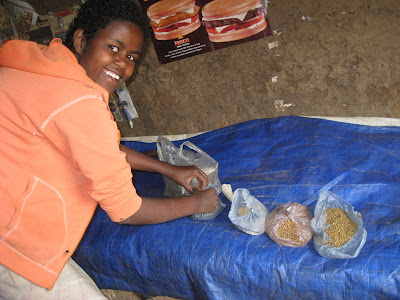
With a stroke of luck we arrived at a mill that had just opened and we would be the first customers of the day.  I’ve been told that this is a very good thing because the amount of powder in the air is minimal and the machine is not yet hot which heats your product to untouchable temperatures.  Being the first ones wasn’t my favorite part even, I was overjoyed that children hadn’t seen us turn in here; we were the only people in sight other than the workers!  The moment of truth had arrived when it was time to pay for the grinding, 1 Birr per kilo, weigh-in time.  Ten kilos of bubere, three of other spices and one of salt.  14 kilos!  Then began the grinding, and I don’t think you can truly know burbere (or Ethiopia) until you inhale burbere and inevitably touch your eye with pepper residue on your hand.  Breathing in that intense pepper is unlike anything else; it feels like your insides are on fire and no amount of coughing will suffice.  But we survived.

Weighing the spices before entering the mill house.

Grinding the pepper together with the spices.
The pepper is in the machine waiting to be ground.
Aregach and me.
Aregach carrying our wonderful bubere back to my house.

A short while later, after taking plenty of pictures and befriending the mill employees, Aragach donned the basin of burbere on her head and we walked to my house proud of our product.  We stirred all the spices together and tasted what our hard work had produced; its brilliant orange color is unlike any color I’ve seen in nature.  I no longer worry about what I will do with 14 kilos (minus Aragach’s share) because this spice sells itself.  I finally have that homemade burbere I’ve wanted and it smells (and tastes) so good that I don’t even mind that my entire house smells of it!
Back at my house with the bucket full of burbere!

10 May, 2010

St. Mary’s: The Ethiopian Block Party

Time is flying by and already I find myself celebrating St. Mary’s holiday without knowing it, again.  Last year you’ll recall I drank coffee with my landlord’s family and neighbors on their front porch, only later to find out this is how they celebrate St. Mary’s holiday.  This year I knew it as soon as I saw it, but still didn’t realize the holiday was approaching until the rest of town was well into their celebration.

Unfortunate scheduling had me rushing to an appointment across town yesterday afternoon to tutor a couple of the orphan boys I met last fall.  I hadn’t done much in the physical movement department on my lazy Sunday so I decided to walk, taking the shortcut through back streets instead of the paved main road.  What I didn’t know from my celebration of the holiday last year was that those without front porches instead celebrate with neighbors out in front of their houses or in the yard within their compounds.

It didn’t take me long to realize the holiday was being celebrated, neighbors from every single celebration calling me to join their party.  I kept repeating my excuse, “I have an appointment, but thank you for inviting me! Happy holiday!” while taking a obligatory scoop of nefro in my hand as I walked away.  Nefro is the holiday specialty treat, a mixture of boiled beans, corn, chick peas and barley eaten by the handful.  A few more persistent neighbors wouldn’t accept my excuse and insisted that I at least sit down for a minute to celebrate with them.

After a few blocks of walking it was comical, literally every celebration bringing me a plate of nefro for me to take a handful from.  At any single point of my journey I had nefro in hand, barely finishing one household’s snack before politely taking some from the next.  It figures that about half way to my appointment my landlord’s family calls me, beckoning me to come drink coffee, and, of course, eat nefro.  I knew I had to go; I already missed their big Easter celebration with neighbors and felt horrible.  I debated turning around, retracing my steps back to my house right then, but thought the path of least resistance (without having to explain my sudden return to every celebration along the way) was to continue to where I was going, which was on the main road, and from there I could get a bajaj taxi back to my house.

The second half of my walk turned out to be the same pace as the first half.  Five steps forward, two steps back, one scoop of nefro, repeat.  I was impressed by how many of the celebrations had at least one person who knew my name, meaning there were hardly any “ferengi” calls.  I finally made it to the main road and waved down a bajaj, never making it to my appointment.  Luckily appointments here are easily rescheduled, and hardly ever obligatory.  And I didn’t disappoint my landlord’s family, whom I’ve come to think of as my own family.  I managed to turn a simple walk across town into a joint-celebration with more families than I can count, on a holiday I didn’t know was going on!

08 May, 2010

The Art of Eating a Mango

Most fruits don’t require instructions or advice. Most fruits don’t need technique and strategy.  But the mango isn’t most fruits.  Having never eaten a mango from its raw state before coming to Ethiopia, I know I will always associate mangos with this time in my life.  I can picture it now, nostalgically strolling through the produce department at an oversized grocery store in America.  Before Ethiopia I probably couldn’t have picked out a mango from a pile of fruit.  But now I consider myself an expert.

Mango season has rolled into town once again; right after the small peaches and right before the big rainy season.  Everything here is measured by produce and weather it seems.  As soon as the mangos make their way from the southern parts of the country where they are grown in abundance, the price begins to drop and you can’t walk three steps without having to dodge a mango pit on the streets.

Eating a mango (unless it’s cut, cleaned, and awaiting you in a plastic container in America) is typically a messy process.  It can range anywhere from a necessary hand-washing to necessary bath and a good ol’ flossing.  This makes it an awkward fruit to simply hand to someone as a snack when they are sitting in your house.  But in Ethiopia, it’s cultural to share what you have, and equally cultural to eat mangoes without cutlery.

The Ethiopian method comes in two forms: ripe and past ripe.  When the mango is ripened, people simply bite off sections of the skin to peel it and then eat the rest like an apple, except messier.  This requires a decent hand-washing and face-washing usually.  If the mango is past ripe (squishy) they bite off an end and just squeeze the juice and innards into their mouth.

The problem with the mango is that there is no place to hold the mango.  The first half is easy: peel and eat.  But the second half is where true innovation comes into play.  And by “innovation” I mean “messiness.”  As you start to peel the second half, it becomes necessary to try to hold onto the slippery pit, which is where the mess begins.

I’ve come to enjoy the messiness, and I’ve embraced the necessary post-mango-eating clean-up, which is a small price to pay for sweet, fresh mango.

05 April, 2010

The Fourth Invitation

To continue my story of Fasika, Easter in Dangila, at 4pm I returned to the house of my fourth invitation of the day.  Earlier in the day I was only able to drop in for a brief serving of duro wat, so of course I was expected to come back later to machewat, play.  More than that, I wanted to go back; I find myself visiting their house just about every day now to hangout with this wonderful family.
Invitation 4: my “house of 5 girls” I call them.  I may have mentioned them before, but I adore this family.  The littlest girl from the family is in my little “street gang” of children that chants my name as I walk to the post office.  I should mention that by “gang” I mean group of toddlers, most of whom don’t wear pants or shoes, but play in the street around my house, and with whom I have a mutual adoration.  One day a while back, I accepted a coffee invitation from this family (meaning they yelled from their house “drink coffee!” as I walked past) and have been an honorary family member ever since.  The mother is very traditional and comes from the rural area while her four daughters are rather modern in comparison.  The eldest of the four moved to Addis a few months back, but left her daughter to be cared for by the family, who is Meskerem, the little girl in my “gang.”  The youngest of the four daughters is mentally handicapped and blind.  The two middle daughters are around my age and know a decent vocabulary of English, so often, when composing sentences will throw in an English noun of two for me.  The second oldest is exactly my age actually, and she will often offer to paint my nails while I’m sitting in their house, which I always kindly accept.  The roughly painted coat of polish typically lasts 3 days and serves as a wonderful reminder of how much I am loved in Dangila for those few days.  I doubt any manicurist in America will ever quite suffice.
Most of all, I love and admire the mother of this family.  How strong would you have to be to not only support four daughters by yourself (ok, husband is around, but let’s just say he doesn’t really do much for the family) but also take in your granddaughter, not to mention the fact that one daughter is handicapped.  This whole family lives in a house the size of my house: a mere 20-square meters.  Ethiopian mothers do everything, especially those not fortunate enough to have a helper like my landlord’s family has.  You prepare injera and wat from scratch, clean the clothes by hand, and sweep the dirt floors until they are spotless.  The work is never ending.  Every time I come by, they insist on feeding me, finding it insulting when I refuse.  On Easter, as a treat, I brought them a half-kilo of coffee beans (worth 30 Birr = $2.50) and the mother, Fantanesh, was beside herself, almost refusing to take it.  I justified the gift by saying that I cannot perform coffee ceremonies, so this is simply all the coffee I drink at their house.  She then wouldn’t let me leave until she prepared a special ceremony just for me.
I always want to give them something; I want to give them everything.  Yet they are so humble, not wanting anything.  Some people don’t know anything about me other than the color of my skin yet boldly ask for money while the people who I know and love won’t even accept the smallest gifts.  It’s hard.

More stories from the “house of 5 girls” to come.  For now, I should end my Easter stories so I can finally digest all the food I ate.

Final Count:
Plates of duro wat eaten: 3
Plates of tebs eaten: 2
Cups of coffee drunken: 9
Number of times I had to remove a sheep’s head from Arbay’s mouth: 3
Piece of raw meat Arbay hid in the sofa cushions: 2

Fasika, Take Two


‘This is wonderful duro wat!’ I complimented my landlord’s wife, as is cultural here in Ethiopia.

‘If it is wonderful duro wat that means it will be a wonderful Easter!’ she replied.

A great omen I thought for the day ahead.  Good thing too, since it was bound to be a long one—that first helping of duro wat was served to me at 6am this morning.

As I prepared my new group 3 neighbors for the biggest Ethiopian holiday celebration, I had one piece of advice for them: don’t over-commit yourself!  I have been anticipating Easter for a month now, and knew that while I was going to thoroughly enjoy the holiday here in Dangila, this year would be different; I wasn’t going to tell more than two families I would come to their houses on Easter.  Somehow, that plan went awry.

Last year I think I accepted any invitation that came my way, an "I’ll-take-what-I-can-get" kind of attitude.  As you can read from my blog last April, I had far too many commitments for one day, and had no idea what I’d gotten myself into.  This year it was a completely different situation; I have so many wonderful and close friends that I simply couldn’t refuse people’s offer for me to spend the holiday with them and their families.  And I knew exactly what I was getting myself into, but I just couldn’t say ‘no.’  Moreover, because I have such close friends it was less an invitation and more a statement of what time I was going to be at their houses on Easter Sunday.  Three such invitations presented themselves throughout the past week and I obliged them all with a grateful acceptance, but I will admit the fourth invitation was not exactly unsolicited.

Knowing Easter was approaching, I couldn’t have imaged not spending part of my day with Tizita’s family, who I spent Easter morning with last year.  Something about having a constant between the two celebrations was appealing, so I planned on having lunch at Tizita’s family’s café on Thursday before Easter, hoping to secure an invitation.  Worked like a charm; I hadn’t even placed my order for lunch before Tizita’s mom asked if I was going to be in Dangila for Easter.

So with all the invitations in place I anticipated a long day with way too much food, but I was looking forward to the festivities as if it were Christmas day! Easter is such a huge holiday here that I suppose I really did get wrapped up in all the preparations and I was also looking forward to finally breaking the fast!  I woke up at 6am and hopped right out of bed, knowing my compound family would already be awake and enjoying the first course of meat for the day.  As soon as they realized I was awake they summoned me inside for a tasty platter of duro wat (chicken stew—the holiday specialty).  For all you injera-lovers out there, well, anyone who actually knows good Ethiopian food, it was more than just good wat, but tequs injera, freshly made within the hour—yum! 

And so the day had begun, the fast had been broken, and my only obligation for the day was to eat! I brought the children some Easter candy and unwrapped a few myself before I witnessed the first sheep slaughtering of the day by my landlord.  Then I was off to Tizita’s family around 9am (I received 3 different times from 3 different family members about what time I should arrive, so I decided on a 9am average).  I was promptly served another platter of duro wat—a whole tequs injera all to myself. As the day began I savored every bit, eating to fill my stomach with the delicious food.  Next came a coffee ceremony with a snack (as is required for the ceremony) followed with a platter of homemade “cheese” (old milk), and I began to realize that fasting has its perks in Ethiopia.  In fact, I realized all of my favorite Ethiopian foods are fasting foods, but I politely ate my fair share of all the holiday goodies.  I knew Tizita and her family would never let me leave before having some of the first platter of tebs from the second sheep of the day I just witnessed slaughtered.  So I waited for the food and finally left after tebs right around noon. 
I loved being invited back to Tizita’s family’s celebration.  It was such a treat for me to be in a familiar place with familiar people and to have an idea of what to expect.  Year 1 here I may have been comfortable with the people, but the traditions surrounding each holiday were still a mystery—moreover, it is like Christmas in America, where every family celebrates in a different way, so it isn’t something you can simply be taught.  Those three hours spent at my favorite little café, with a family who loves me and knows me was relaxed and easy.  And although it had differences from the year before, the major constant, which I expected, was that for those three hours I continually had a plate of food in front of me, and was continually told, “Be!” eat!

I should have known that appointment would have lasted until noon, but I guess I was optimistic about the amount of time it takes to slaughter a sheep, so now I found myself with my third invitation starting at noon and had just received a phone call from the fourth telling me to come now!  I swung by number four, ate a quick plate of duro wat, ran home to grab some candy for the kids at the next house, and luckily caught a bajaj to the other side of town for invitation number three: Yebeletal and his family.  He is my co-teacher for the English Club and a wonderful friend; his house had recently become a place I have frequented, especially since his wife just had a baby girl whom I adore!
Arriving 30 minutes late for the appointment, I was surprised to see that I was the last to arrive—surprised because Ethiopians are never on time.  However, I was greeted with warm smiles, holiday wishes, and not a mention of my lack of punctuality.  I was served several cups of coffee right away, we had a blessing from the elder in the house (Yebeletal’s father-in-law), and my third sheep slaughtering of the day commenced.  There came a point in the day where the meals became less of a treat and more of an obligation, and the instruction, “Be!” was less a friendly reminder and more a dreaded command.  I really enjoyed socializing with Yebeletal and his family for the two hours I was at his house, and one of my favorite things about him is his great English.  And we often chat about cultural differences, so he knows that I don’t like certain Ethiopian foods, namely, qeybay, butter with spices.  So while I was absolutely full, I really did look forward to the tebs made exactly the way I like them.  And you really can’t complain about meat that fresh, so I slowly but surely ate the food placed in front of me.

At 2:30pm I bid farewell to Yebeletal and family, waddled out to catch a bajaj wishing my skirt had a button to unfasten, and made my way home thinking I had until 4pm to rest up.  I let the kids come inside and watch a DVD on my laptop (Enchanted was the pick of the day) and I happily lounged on the sofa for about 30 minutes until my landlord’s wife called me in for “coffee”… but it’s never just coffee.  I sat around with my landlord, his wife, and one remaining guest while they fed me dulet and a beer and told me how I’d disappeared for their coffee ceremony—oops!  I actually preferred the calmness of just being with them though instead of the chaos of the ceremony where all the neighbors cycle in and out, despite their disappointment (in my defense they never told me what time their coffee ceremony would be).  I then watched a bit more of the movie with the kids and at 4pm went back to the house of invitation four, with whom I’d only briefly eaten duro wat before.

For now, I’m going to leave you waiting—I’ve decided to write about the rest of the day tomorrow.  The story about my “fourth invitation” family is extended, so I’ll make this a two-part entry.

to-be-continued…

29 December, 2009

Welcome To Dangila


This past month I had the privilege of hosting my mom, dad and brother in Dangila for three days.  When I was planning our Ethiopia-section of their time in Africa, I thought about all the historical places I wanted them to see- Lalibela, Gondar, Bahir Dar.  But when it really came down to booking how many days I wanted to spend in each place, I immediately knew I wanted them to spend the most time in Dangila.  Not only did I want them to experience my home, and way-of-life, but I wanted them to meet all my friends and drink more coffee than they could handle, just as I did when I first arrived!
Our time spent in Lalibela, Gondar, and Bahir Dar was fabulous.  The sites in Ethiopia are spectacular and one-of-a-kind, but my favorite part of having them here was the hospitality received in Dangila.  I knew I had some wonderful friends here, but the warm welcome they gave my family was so special and unrivaled.  The first night in Dangila, we were invited over to Ali and Billie’s house.


They used to live in my compound, but moved out a few months ago into a bigger house nearby.  We all sat in their living room and spoke in broken English, while I translated the rest of the details back and forth.  They served us a plateful of injera and wat; some of the best I’ve had in Ethiopia!  I was a little nervous about having my family taste Ethiopian food in a restaurant the first time, but at least there, you can openly say something doesn’t taste great.  At a friend’s home, it is a bit harder to reject the food!  Luckily, the food was well received by my family.  Thanks for being troopers family.   Then, as we were putting our plates down, satisfied by the delicious food, another round of plates came out!  That’s right, another plateful, but this time it was western food! Spaghetti, tomato sauce (with burbere spices of course) and bread; we all looked at each other with wide eyes.  We graciously accepted the second dinner and followed it by a coffee ceremony, although there was quite a bit of food left over.
The next night we had yet another two-course meal, featuring almost all the same foods! It was amazingly thoughtful how all my Ethiopian friends catered to our needs and welcomed us into their homes.  My favorite part of coming to my town was the night we first arrived, after the first marathon meal, my friends Tigist and Tewelde awaited us back near my house.  They were so excited about meeting my family, and they came bearing gifts.


They had an “Ethiopian” beaded bracelet for each of them, freshly made local bread, local-made potato chips, and Christmas cards for us!  It was the nicest thing.  Then they escorted my family back to their hotel on the main road.

It truly brought tears to my eyes.  The hospitality here and love I receive from all my Ethiopian friends is truly the reason I am still here.  They teach me something new every day about selflessness and generosity.

21 April, 2009

Happy Easter and Melkom Fasika!


I don’t normally eat meat at 7am.  I’m not normally even awake at 7am.  However, this is just one difference between American Easter and Ethiopian Easter, which they call Fasika.  To start with, you should clear your mind of pastel colors, sugary candy, and bunnies carrying baskets of colorful eggs (by the way, thank you America for having the weirdest traditions ever, it makes explaining American Easter so simple).  As I have mentioned previously, Ethiopians have a completely different calendar system, so they celebrated Easter a week after the rest of the world.  Fasika is probably the biggest holiday celebrated here, comparable to the American Christmas celebration and hype (well, who am I kidding, nothing even compares to the Christmas hype in America).  Good Friday was a national holiday and even before Friday, people started traveling to their hometowns to be with their families.  In the Orthodox religion, they fast from all animal products for 55 days before Easter, so building up to the big celebration, the animal section of the market began to grow massively.  Walking down the streets on any Monday, Thursday or Saturday you were bound to see proud new owners of sheep and goats leading their purchase home on a rope leash.
Starting with that 7am knock on my door, I will walk you through my very fascinating Fasika experience.  It took a few minutes I am sure for me to realize the knock, knock, knock was on my door.  I rolled over, noticed the time, knew it was Sunday, and almost went back to sleep.  Then I remembered that it was Fasika, and knew it was time to start my culture-filled day.  I opened the door to find Eyerus, the 7-year-old daughter of my landlord, telling me in Amharic that is was time to come eat.  The night before I had seen my landlord kill a chicken, which his wife along with the two worker-girls began cooking.   Around midnight many Orthodox go to church service that lasts until 4am.  After the Easter service, the fast is over and it is time to eat meat!  I found out that I was lucky they waited until 7am to wake me, as they started eating at 5am!  I sat with my landlord and his family and ate a healthy serving of duro wat, chicken stew, with injera of course.  After I finished eating I had some time to rest, I thought, before I had to make my first appointment for the day.  Leading up to Easter most of the people I have befriended in Dangila insisted that I come to celebrate Easter with their family.  Everyone was so welcoming and I felt so blessed for the invitations.  I decided to celebrate with four different families, and everyone who asked after that, since they wouldn’t take “no” for an answer, made an appointment with me to join them for a meal later in the week.

Well, after I ate duro wat I headed back into my house to rest when I heard the sharpening of knives coming from the back yard.  It didn’t even faze me for a couple minutes, and then I realized that they must be preparing to slaughter the sheep! I’m not one for guts and gore, but I am one for new experiences, and seeing a sheep slaughtered on Fasika is like decorating a tree for Christmas, necessary.  Little did I know that this wouldn’t be the only sheep slaughtering I would witness for Fasika.  It was around 7:30am when the episode began, and I watched my landlord and his 12-year-old son as they dissected the animal that my dog had been chasing for a week before.  It was more of an anatomy lesson than I ever received in high school.  While I decided that pictures of such an event were not necessary, Eyerus begged me to use my camera until I gave in.

9:05am I began walking to my favorite restaurant across from my office where the owner, Tizda, invited me to celebrate with her family.  I arrived a little late, but punctuality is often overlooked in this country, so it was not a problem.  In fact, it was 9:45am before the first cup of bunna, coffee, from the ceremony was poured.  Bunna qurs, a snack food that goes along with the bunna ceremony, today was injera spread with a mixture of butter and berbery (spicy crushed peppers).  I learned that this was a traditional bunna qurs for Easter because butter is an animal product, which could not be eaten during fasting.  Sometime after arriving, they served me a plate full of duro wat and I happily ate as I observed the festivities of the family surrounding me.  It was 10am when one of the brothers led a sheep by a rope collar into the restaurant area where we were all seated.  I thought maybe they were showing off the sheep to the family before taking it around back to slaughter; I was wrong.  Ten minutes of wondering later, they began slaughtering the sheep in the room where we were all sitting.  Needless to say, I won’t feel awkward ever again about simply bringing my dog inside when I stop by to buy bread! After killing the sheep, they first cut out the tongue.  I realize this is gross, but I witnessed it, so you can read about it.  I watched the elderly mother of the family cut up the tongue meat and hand feed it to everyone in the room as a sign of respect.  When she offered it to me I politely declined, saying that I do not eat raw meat; about ten minutes later she came over to me with a piece cooked especially for me and I couldn’t turn down her thoughtful gesture.  After the final two rounds of the coffee ceremony, they insisted that I stay to eat some of the freshly prepared sheep meat, and it was around 11:45am when I returned to my house.


Just as I sat down to take a deep breath and literally digest my morning, my landlord knocked on my door and invited me inside.  Every household prepares coffee and a meat stew for Easter and then you invite neighbors over to celebrate and eat, so each house I went to there were also many other friends and family cycling in and out of the house.  It was noon when I took a seat in Ato Belacho’s house and was served bunna qurs, and for the next hour, I socialized, drank three cups of coffee, and ate sheep wat.

 I had just one hour to allow myself to rest before walking to my next appointment for the day at 2pm.  The Head of the Bank, whom I have gotten to know over the past two months, invites me over just about every weekend to socialize with his family, so I could not decline the Easter invitation.   I spent an hour there where I ate bunna qurs, duro wat, and drank two cups of coffee before excusing myself to head to their neighbor’s house.
3pm I met my friends Getameh and Manny where they fed me sheep wat and a couple rounds of coffee.  Ethiopians are very forceful when it comes to eating, and “no” is not really listened to when the ladles of food are being scooped onto your plate.  This was a fact I overlooked when booking the four appointments for the day.  It was 5pm when I waddled home, filled to the brim with meat and coffee.

6:30pm my landlord offered me some sheep, and I said that I was way too full.  He then corrected his statement, asking if I wanted some of the sheep meat to cook myself.  In broken Amharic, I still turned down the offer, not even able to imagine a time in the future where hunger would be an option.  A few minutes later, his middle son, 9-year-old Yenebeb, knocked on my door with a container of sheep meat. Like I said, “no” is often ignored.  I thanked him for the gift, re-packaged the meat into a Tupperware and took it to store in Ato Belacho’s fridge I use on occasion.  I am blessed to have such caring neighbors surrounding me!

All in all, I had the experience I wanted.  I have successfully experienced Fasika for all it’s worth!  Many people continue the celebration all week though, not returning to work.  Neighbors I have learned take turns hosting dinners and lunches throughout this week, and I have already set up two lunches and two dinners for various days. Many times in fact, it is not so much of an invitation to eat, as it is a knock on my door and the imperative statement, “eat!”


24 February, 2009

Super Eggs, Not Supermarkets

Just yesterday I wrote about my adventures in perfecting my culinary skills, that I find myself with an abundance of new accomplishments which I feel like sharing (and bragging about). I am living in Ethiopia though, so if I want to brag about washing my dishes in buckets on my floor without running water, I am going to let myself.


Much of my time this week has been exploring my town and finding little shops that I like. More than just buying flour or popcorn kernels, I talk to the owner in my broken Amharic, and try to make a friend. Not only do I enjoy getting to know new people here in Dangila, but finding those shops that I will be able to go to and trust that the owner is not giving me a "ferengi price" will make my days easier in the future.
Shops here line the small dirt roads around town, each with the same set-up, but very different products. From the road in fact, they all look identical. As you approach the shop, which is just a small room, you stand outside and look over all the items for sale on the two sides, and back walls. From floor-to-ceiling there are boxes of items displayed. On the front-side of the shop there is a waist-high counter which the shop owner will stand behind, awaiting your request. The shop may contain a little bit of everything, or it may be just three varieties of cups, but regardless, even duplicate items are stacked high.

Most shops though carry a limited variety of items, as in I must go to one shop for fruit, one for vegetables, one for meat, one for bread, one for baking materials like flour or sugar. The idea of a supermarket is still only in major cities in Ethiopia. It is funny how the concept of not finding everything in one simple store is foreign to me; a supermarket is really all I have ever known.

I have taken to liking the adventure of wandering the streets in search of shops that carry items on my "need to buy" list. I know all curiosity is peaked as I meander through uncharted streets on my limited mental map of Dangila. When I stray from my usual path though, I tend to develop a rather large following of children, which on the right day can be entertaining (other days, or, most days, it is not my favorite thing). The worst is when the children hear me ask for a particular item at one shop and then follow me to the next shop and ask the shop owner for me. I hear them all repeating the name of the item; yesterday is was a teacup. "She wants a teacup! She wants a teacup!" each will tell the child next to him or her. It turns my adventure from a 'practicing shopping vocabulary' trip into a 'practicing how to talk to children' trip.

My egg lady's shop.
I am still searching for the perfect teacup, have yet to find a fork for sale in my town, and I do not yet have a favorite fruit shop. My big accomplishment this week though was finding my "egg lady." She is just a couple minute walk from my house, and the first time I approached the shop a chicken wandered up besides me and flapped itself onto the counter between the shop owner and myself. I say it added to its charm. My favorite part about buying my eggs there is that when I ask for eggs, she has to go look for them; the original egg hunt, not just reserved for Easter. She will leave the shop area and go out back to find the eggs. A supermarket has its conveniences, but this is fresh!

My egg lady.