
My big assignment during my first three months in Dangila is to assess the needs. You can do this in several different ways, such as, random surveys, simply talking to various people, or by conducting an official meeting. I have been talking to people for a couple months now and finally decided to have an actual needs assessment meeting to see what I could find out.
I began a few weeks ago talking to my supervisor about this meeting that I wanted to hold. I explained briefly what I wanted to do during the meeting and he agreed to help me arrange it. Fast forward to the day before the meeting; at this point, I am under the impression that the meeting is set and all is well. “The mayor has finally approved your meeting!” my supervisor tells me. “Now we must send out a notice to all the government offices to announce it.” Oh??
It turns out that hosting a meeting for the government employees means we must get official approval from the mayor and send out an official announcement. I thought that it would be a word-of-mouth event, and I thought that invitation had been orally passed on a week ago!
“No problem,” he tells me, “we will just get our secretary to type up the announcement… oh, but she has not come back to work since Easter and we do not know where she is.”
“Is there something we can do about that? Can you type Amharic?”
”I will get a secretary from another government office to volunteer.”

It is now two hours until our office closes on the day before my meeting. Tilahun, my supervisor, finally writes up the announcement, gets that approved by the mayor and finds someone willing to type the half-page note. Ok, no problem, we still have two hours to type up the note and distribute it. Tilahun tells me that there is a messenger that can easily deliver the note to all 18 offices, clustered in a stretch of road no longer than half a kilometer. I patiently wait as I watch Tilahun photocopy the paper one copy at a time because the machine we use only semi-works. Then, I become slightly antsy as I watch him take the note to the mayor one more time; the mayor then hand signs and stamp two official markings on each note. Stamping things is a big deal here. Each piece of paper that leaves our office must be stamped, with stamp and inkpad, for reasons beyond me. Then I eagerly watch Tilahun handwrite an extremely long identification number, and date on each paper. When I am about to burst he reaches for two more stamps to finally make the notice ready-to-go. With just 15 minutes before offices close, I took a sigh of relief as I watch the letters pass into the messenger’s hands.
.JPG)
I arrive at my office when it opens at 8:30am the next morning to finish some final preparations for the meeting taking place at 9am. Tilahun chuckles as he tells me “we” put the wrong date on the notice yesterday (note: the date was using the Amharic calendar, which I have no idea how to convert). I am less-than-amused, but not a problem as Tilahun calls each of the 18 offices quickly to make sure they understand the meeting is today. Why we couldn’t have made those 18 phone calls yesterday afternoon and avoid all that stamping nonsense, I am not sure. Finally, we casually stroll over to the meeting hall at 9:05am and I snickered thinking about how early I would have arrived in America for a meeting I was hosting. I also knew ahead of time that when we arrived, ten minutes late, no one would be there yet. I was right. What I had not anticipated was that 45 minutes later I would be sitting in the meeting space with my counterpart and one attendee.
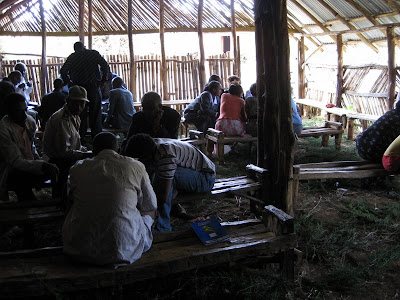
I am not even sure why I waited that long. I was just daydreaming I suppose and time passed without my knowledge. Finally, three more people showed up, and then I walked out to the entrance of the recreational center where the meeting was located, and several more people were waiting to attend also, playing table tennis while they waited. Then, by 10am, almost 15 people showed up! By the time the meeting started, and hour and fifteen minutes late, 21 people were ready to participate!
.JPG)
I had given up on the meeting, I really had. I had already started to think about when we should reschedule; the possibility of enough people arriving an hour late was not an option in my mind. Just when I think I’ve had enough, Ethiopia pulled through. I had a very successful meeting that lasted over two hours! I will talk some about the results in weeks to come, but for now, I am just overwhelmed with joy that it actually happened!
I began a few weeks ago talking to my supervisor about this meeting that I wanted to hold. I explained briefly what I wanted to do during the meeting and he agreed to help me arrange it. Fast forward to the day before the meeting; at this point, I am under the impression that the meeting is set and all is well. “The mayor has finally approved your meeting!” my supervisor tells me. “Now we must send out a notice to all the government offices to announce it.” Oh??
It turns out that hosting a meeting for the government employees means we must get official approval from the mayor and send out an official announcement. I thought that it would be a word-of-mouth event, and I thought that invitation had been orally passed on a week ago!
“No problem,” he tells me, “we will just get our secretary to type up the announcement… oh, but she has not come back to work since Easter and we do not know where she is.”
“Is there something we can do about that? Can you type Amharic?”
”I will get a secretary from another government office to volunteer.”

It is now two hours until our office closes on the day before my meeting. Tilahun, my supervisor, finally writes up the announcement, gets that approved by the mayor and finds someone willing to type the half-page note. Ok, no problem, we still have two hours to type up the note and distribute it. Tilahun tells me that there is a messenger that can easily deliver the note to all 18 offices, clustered in a stretch of road no longer than half a kilometer. I patiently wait as I watch Tilahun photocopy the paper one copy at a time because the machine we use only semi-works. Then, I become slightly antsy as I watch him take the note to the mayor one more time; the mayor then hand signs and stamp two official markings on each note. Stamping things is a big deal here. Each piece of paper that leaves our office must be stamped, with stamp and inkpad, for reasons beyond me. Then I eagerly watch Tilahun handwrite an extremely long identification number, and date on each paper. When I am about to burst he reaches for two more stamps to finally make the notice ready-to-go. With just 15 minutes before offices close, I took a sigh of relief as I watch the letters pass into the messenger’s hands.
.JPG)
I arrive at my office when it opens at 8:30am the next morning to finish some final preparations for the meeting taking place at 9am. Tilahun chuckles as he tells me “we” put the wrong date on the notice yesterday (note: the date was using the Amharic calendar, which I have no idea how to convert). I am less-than-amused, but not a problem as Tilahun calls each of the 18 offices quickly to make sure they understand the meeting is today. Why we couldn’t have made those 18 phone calls yesterday afternoon and avoid all that stamping nonsense, I am not sure. Finally, we casually stroll over to the meeting hall at 9:05am and I snickered thinking about how early I would have arrived in America for a meeting I was hosting. I also knew ahead of time that when we arrived, ten minutes late, no one would be there yet. I was right. What I had not anticipated was that 45 minutes later I would be sitting in the meeting space with my counterpart and one attendee.

I am not even sure why I waited that long. I was just daydreaming I suppose and time passed without my knowledge. Finally, three more people showed up, and then I walked out to the entrance of the recreational center where the meeting was located, and several more people were waiting to attend also, playing table tennis while they waited. Then, by 10am, almost 15 people showed up! By the time the meeting started, and hour and fifteen minutes late, 21 people were ready to participate!
.JPG)
I had given up on the meeting, I really had. I had already started to think about when we should reschedule; the possibility of enough people arriving an hour late was not an option in my mind. Just when I think I’ve had enough, Ethiopia pulled through. I had a very successful meeting that lasted over two hours! I will talk some about the results in weeks to come, but for now, I am just overwhelmed with joy that it actually happened!





 Posts
Posts


